
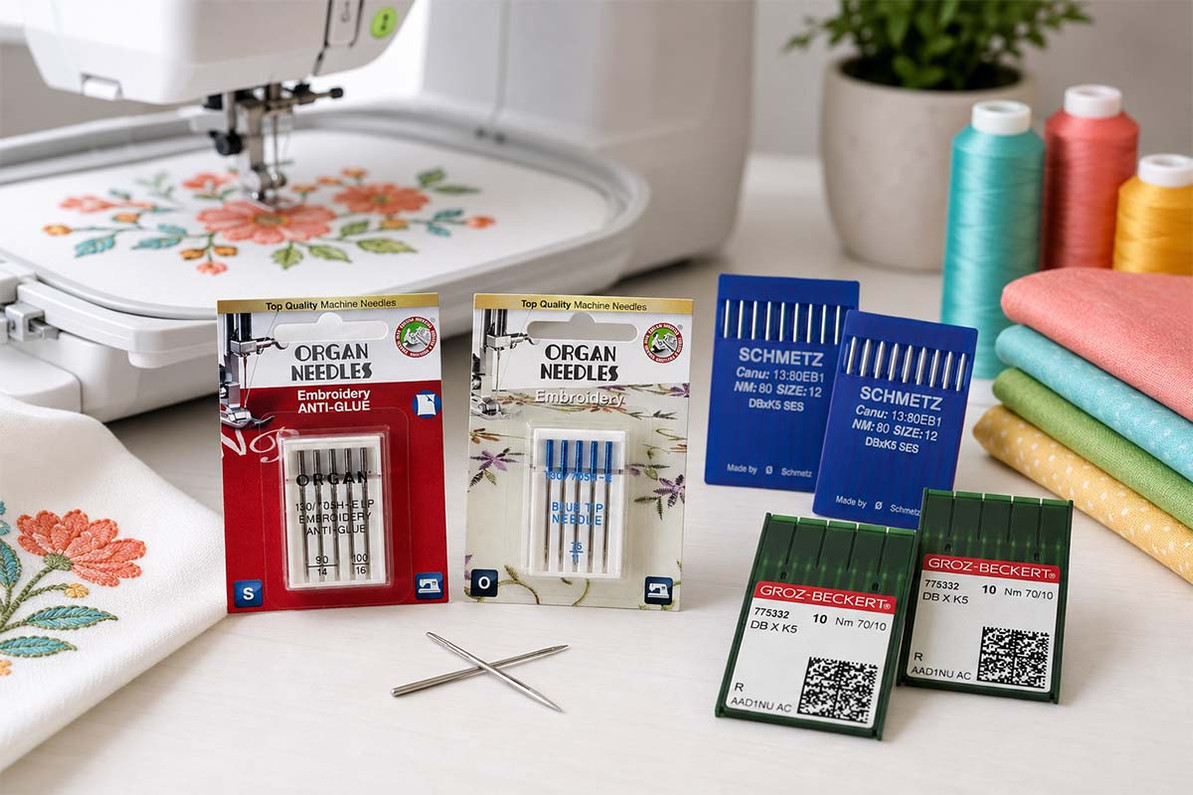
Machine Embroidery Needles: Sizes, Types & How to Choose
Machine Embroidery Needle Guide
Machine Embroidery Needles Explained: Sizes, Points & How to Choose the Right One
Key Takeaways: Start by confirming the needle system your machine requires. Then match your needle to the thread, fabric and project. Common embroidery sizes include 65/9, 70/10 and 75/11, while heavier or specialty threads may need a larger needle.
Your embroidery needle is small, but it has a big influence on stitch quality.
When thread starts shredding, stitches skip or a design suddenly does not look right, the needle is one of the first things worth checking. Fortunately, choosing one becomes much easier once you understand a few basics about needle systems, sizes, points and thread compatibility.
Jump to a Section
Parts of a Machine Embroidery Needle
Several parts of the needle work together to help your machine form clean stitches.
Shank: The upper portion that fits into the machine's needle holder.
Blade or Shaft: The main body of the needle. Its diameter determines the metric size.
Groove: Helps guide and protect the upper thread as the needle passes through the fabric.
Eye: The opening the embroidery thread passes through.
Scarf: The indentation near the eye that helps the machine's hook catch the thread loop.
Point: The part that enters the fabric first. Point style matters because different fabrics respond differently.
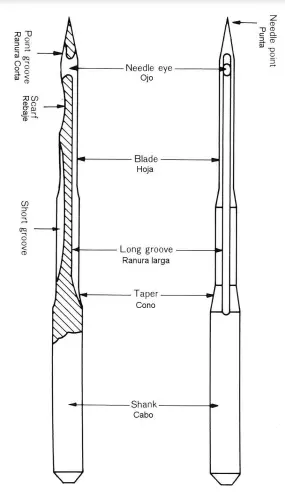
Machine needle anatomy reference
Check the Needle System First
Needle size and needle system are not the same thing. Two needles can both be labeled 75/11 and still be made for different machines.
Many home embroidery machines use household-style flat-shank needles, while commercial-style machines may use round-shank systems such as DBxK5.
Always check your machine manual first. Once you know the correct system, then choose the size and style that fit your thread and fabric.
Looking for Embroidery Needles?
Sit n' Sew carries machine embroidery needles from Organ, SCHMETZ and Groz-Beckert.
What Do Sizes Like 75/11 Mean?
Machine needles are commonly marked with two numbers, such as 65/9, 75/11, 80/12 or 90/14.
The first number is the metric or NM size. A size 75 needle has a blade diameter of approximately 0.75 mm. The second number is the corresponding American size.
Smaller number = finer needle
Larger number = thicker needle
| Size | Typical Use |
|---|---|
| 65/9–70/10 | Fine thread, delicate fabrics and lighter embroidery combinations. |
| 75/11 | A common everyday embroidery size. |
| 80/12–90/14 | Heavier fabrics, heavier thread or specialty combinations when appropriate. |
| 100/16 | Some very heavy decorative or specialty threads. |
These are starting points, not universal rules. Your thread, fabric and design all matter.
Match the Needle to Your Embroidery Thread
Thread weight is one of the best clues when choosing a needle. Fine thread may work better with a finer needle, while heavier decorative or specialty thread needs enough room to move through the eye and groove without excessive friction.
That is why 75/11 is a common size, not a one-size-fits-all answer.
Keep This Needle Guide Handy
The Sit n' Sew Quick Reference Needle Guide matches embroidery thread types and weights with recommended needle sizes, including rayon, polyester, metallic, matte and specialty threads.
When several sizes are listed, the smaller size is preferred for delicate designs and fabrics, while the larger recommended size may be better for other applications.
Sharp or Ball Point?
Needle size tells you how thick the needle is. The point tells you how it enters the fabric.
Sharp Point
Sharp points penetrate fibers directly and are commonly used with woven or tightly woven materials.
Ball Point
Ball points have a rounded tip that moves between fibers, making them especially useful for knits and stretchy fabrics.
Tip: Think about fabric construction, not just thickness. A knit and a woven fabric of similar weight may stitch better with different needle points.
When Is a Specialty Needle Useful?
Titanium-Coated Needles
Titanium coatings improve wear resistance and can be useful for dense stitching, repeated embroidery or demanding materials.
Anti-Glue Needles
Anti-glue needles are helpful with adhesive-backed materials, sticky stabilizers and other projects where residue can build up on the needle.
Metallic & Specialty Thread Needles
Metallic and heavier decorative threads may need a larger needle or additional eye clearance to reduce friction and shredding.
Shop Single-Head Embroidery Needles
A Simple 5-Step Needle-Selection Process
1. Confirm the needle system. Check your machine manual first.
2. Check your thread. Identify the thread type and weight.
3. Look at the fabric. Consider both weight and construction.
4. Consider the design. Dense fills, tiny lettering and specialty techniques can change needle needs.
5. Test the combination. Stitch on similar fabric and stabilizer before the final project when possible.
When Embroidery Goes Wrong, Check the Needle
A worn, damaged or poorly matched needle can contribute to:
- Thread shredding or repeated breaks
- Skipped or uneven stitches
- Large needle holes
- Fabric damage
- Clicking or popping as the needle enters the fabric
Easy first step: Before changing several machine settings, install a fresh needle of the correct system, size and style.
Replace a needle immediately if it is bent, damaged or causing obvious stitch-quality problems.
What About Single-Head and Multi-Head Needles?
For most home embroiderers, the best place to start is Sit n' Sew's single-head embroidery needle selection. Organ offers many of the consumer-machine needle options in the SNS assortment.
Commercial-style single-head and multi-head machines may use systems such as DBxK5, so always confirm the exact needle system your machine requires.
Find the Needle That Fits Your Embroidery
Browse embroidery needles from Organ, SCHMETZ and Groz-Beckert.
Using compatible production equipment? Browse Multi-Head Embroidery Needles
Machine Embroidery Needle FAQ
What size needle should I use for machine embroidery?
There is no single size for every project. Common 40-weight embroidery threads may use sizes such as 65/9, 70/10 or 75/11, depending on the fabric and design.
What does 75/11 mean?
The 75 is the metric needle size and corresponds to a blade diameter of approximately 0.75 mm. The 11 is the American size designation.
Should I use a sharp or ball point needle?
Sharp points are commonly used with woven fabrics. Ball points are often better for knits and stretch fabrics.
Why does my embroidery thread keep shredding?
A worn needle, an unsuitable needle size or eye, excess friction, incorrect threading or another setup issue can all contribute. Replacing the needle is a simple first troubleshooting step.
When should I use an anti-glue needle?
Anti-glue needles are designed for projects using adhesive-backed materials, sticky stabilizers and similar products that can leave residue on an ordinary needle.
Keep the SNS Needle Guide Nearby
Quickly compare embroidery thread types and weights with suggested needle sizes.
Ready for Your Next Embroidery Project?
Find machine embroidery needles from Organ, SCHMETZ and Groz-Beckert at Sit n' Sew Fabrics.
Recent Posts
-
Machine Embroidery Needles: Sizes, Types & How to Choose
Machine Embroidery Needle Guide Machine Embroidery Needles Explained: Sizes, Points & How to Cho …Sep 10th 2026 -
Scrappy Pumpkin Patch Wall Quilt Tutorial with 5" Squares
Free Fall Quilt Tutorial Scrappy Pumpkin Patch Wall Quilt Tutorial with 5" Squares Key Takeaways: …Sep 2nd 2026 -
12 Spooky-Cute Designs & Projects to Stitch
Halloween Embroidery Inspiration 12 Halloween Embroidery Ideas for Spooky-Cute Projects Key Takea …Aug 10th 2026