null
Perfect Half Square Triangles

Perfect Half Square Triangles

Sit n’ Sew Fabrics • Quilting Tutorial
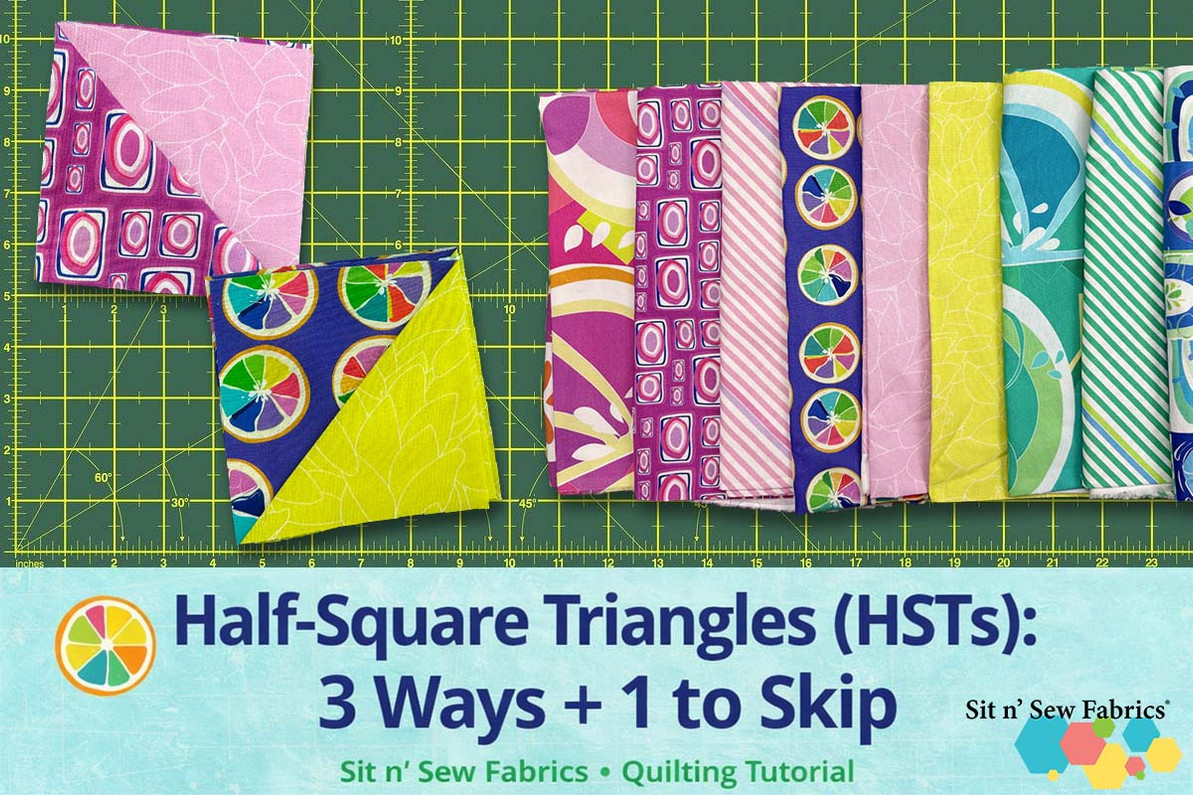
Half-Square Triangles (HSTs): 3 Ways + 1 to Skip

Half-square triangles, commonly called HSTs, are one of the most popular quilting units around. They're part of many, many quilt blocks and make a great quilt all on their own. 

Did you know there are multiple ways to make them? 

We'll show you 3 different methods and explain when to use each. And then we'll show you a 4th method that pops up frequently and explain why NOT to use it. 

HST Methods: Every half-square triangle method creates the same results: 2 triangles that come together to make a square unit. The differences are in what you start with. 

For this tutorial, I used these fun, bright prints from the Citrus Pop collection. It's available in yardage and in precut 5" squares (coincidentally, these are great for making HSTs!)
Method 1: 2-at-a-time HSTs
When to use this method:
* When you're making fewer than 8 matching HSTs
* When you're making larger HSTs
* Anytime if this is your preferred method - it's the most popular and the easiest!

Step 1: Start with (2) squares that are 1/2" larger than your desired unfinished HST size. Draw a diagonal line from corner to corner on the wrong side of (1) square. 

Step 2: Layer the squares right sides together, matching raw edges. Stitch 1/4" on each side of the drawn line. 

Step 3: Cut apart on the drawn line. This yields (2) HST units. 

Method 1 Step 3 Method 1 Step 3 result

Step 4: Align the 45-degree line on a square ruler with the diagonal seam line. Trim unit to desired size (in this case, 4-1/2" square). 

Here are your finished HSTs! 
Use this cutting chart to calculate your starting square sizes:
Method 2: 8-at-a-time HSTs
When to use this method:
* When you're making more than 8 matching HSTs
* When you're making a large quantity of matching HSTs

Step 1: Add 1/2" to the desired unfinished size and then double that number. Start with (2) squares that size. Draw (2) diagonal lines from corner to corner on the wrong side of (1) square. 
Step 2: Stitch 1/4" on each side of both drawn lines. 
Step 3: Cut the stitched unit in half in both directions. Note: Measure in from the edge of the unit to find the center points. 
Method 2 Step 3 Method 2 Step 3 result
Step 4: Cut each square on the drawn line to make (8) units. 
Step 5: Press units open and use a ruler to trim up to desired size. 8 at a time, ready to go!
Use this cutting chart to calculate your starting square sizes:
Method 3: Triangle HSTs
When to use this method:
* When you're making single HSTs
*When you want really scrappy HSTs
* When you want to fussy cut the fabric to center a motif or make sure a directional print is showing the way you want it.
* If you're using an AccuQuilt or Cricut with an HST die - these are designed specifically to make this technique easy and eliminate the need for trimming.
Step 1: Start with (2) squares that are 1/2" larger than your desired unfinished HST size. Cut each square in half diagonally from corner to corner. (4 squares are shown here to demonstrate scrappy results)
Step 2: Pair up triangles to make desired groupings. 

Step 3: Lay (1) triangle right sides together on the second triangle, aligning raw edges. Stitch down the long edge, being careful not to stretch the long edge. 
Step 4: Press units open and use a ruler to trim up to desired size. Scrappy, unique HSTs!
Method 4: Avoid the Bias Trap!
This method pops up online, and I recommend avoiding it, because your HSTs will have bias (stretchy) edges, making piecing them into a quilt trickier. I only mention it because people get it excited about it, but it's not a great choice.
Step 1: Layer (2) squares right sides together, matching raw edges. Stitch 1/4" from the outer edge of the squares, all the way around. 
Step 2: Cut the stitched unit diagonally in half in both directions. 
Step 3: Press each unit open and square up. Those outer edges are cut on the bias and will stretch!
I recommend you try out all 3 HST methods - you might just find a new favorite! I hope these methods help as you work on a future quilt project. 
Feb 19th 2026 Lisa Ruble for Sit n' Sew Fabrics

Recent Posts